30 Aug 2026
With thefirst Major League Baseball game in Apple Immersive Video (AIV) for Apple Vision Pro (AVP) considered a strong success, and the National Basketball Association games earlier this year also providing exciting experiences, sports in Apple Immersive Video appear to be a strong use case for Apple Vision Pro.
Given the size of a baseball field, I was surprised that baseball worked as well as it did in AIV. Still, except for the batter and catcher—and the pitcher to some extent—most of the players were relatively small and blurry throughout much of the game, like low-textured characters in a video game. AIV cannot directly provide a traditional zoom capability, although Apple compensated somewhat with a virtual Jumbotron display.
One aspect of baseball that works to Apple's advantage is that much of the action is centered around home plate, with batters trying to hit the ball. On the relatively rare occasions when the ball was put into play—including a single home run in Apple's first AIV game—Apple showed replays between innings using alternative camera angles that provided better views of the action, especially for the outfielders. This worked in part because baseball has natural breaks when teams switch between hitting and fielding.
Thus, while baseball has a large field, some unique characteristics of the game work to AIV's advantage.
What Makes a Sport a Good Fit for Apple Immersive Video?
AIV's key strengths include its 180-degree field of view, both horizontally and vertically, and its stereoscopic view of subjects that are relatively close to the camera—perhaps a few tens of meters away or less. As mentioned above, AIV does not naturally provide the equivalent of a conventional camera's optical zoom.
Sports with a strong AIV fit tend to have characteristics such as:
Key action takes place within a relatively constrained space.
The immersive camera can be safely positioned close enough to the action for athletes to appear large and clear while taking advantage of AIV's stereoscopic 3D effect.
Athlete movement includes a significant vertical or depth component, taking advantage of AIV's enormous field of view and stereoscopic presentation.
The location of the action is reasonably predictable, allowing cameras to be positioned close to the athletes without interfering with the competition.
The sport offers camera positions that can make viewers feel as though they occupy a premium—or even impossible—seat.
The first criterion deserves some qualification. The entire playing field does not necessarily need to be small. What matters more is whether the sport has relatively small and predictable action volumes where its most compelling moments occur.
Baseball provides an example: the field is enormous, but much of the game's recurring action is concentrated around home plate. Pole vault has a long runway, but its most spectacular action occurs around the box, standards, bar, and landing pit. A cross-country equestrian course may stretch for kilometers, but the most spectacular action repeatedly occurs at known obstacles.
If immersive cameras can be safely positioned near these action volumes, the overall size of the sporting venue becomes less important.
A secondary consideration is the popularity of the sport, both in terms of broad appeal and the passion of its core fans, particularly fans already accustomed to paying for premium viewing experiences.
Based on these criteria, several categories of sports appear particularly promising.
Gymnastics
Rings, parallel bars, uneven bars, pommel horse, vault, trampoline, floor exercise, rhythmic gymnastics
Gymnastics may be particularly well suited to AIV. Most apparatus events take place within a small and highly predictable volume, allowing immersive cameras to be positioned relatively close to the athletes without interfering with them.
Just as importantly, gymnasts move vertically, rotate through space, and frequently move toward and away from the viewer. Rings, vault, uneven bars, parallel bars, and trampoline could be especially impressive in stereoscopic immersive video.
The apparatus also provides a useful sense of scale. Watching a gymnast perform on the rings from several meters away could convey the athlete's height, movement, and physical strength in ways that conventional television tends to flatten.
Gymnastics also has substantial mainstream appeal, particularly during the Olympics, making it an unusually strong combination of popularity and AIV fit.
Ring and Cage Combat Sports
Boxing, kickboxing, Muay Thai, MMA/UFC
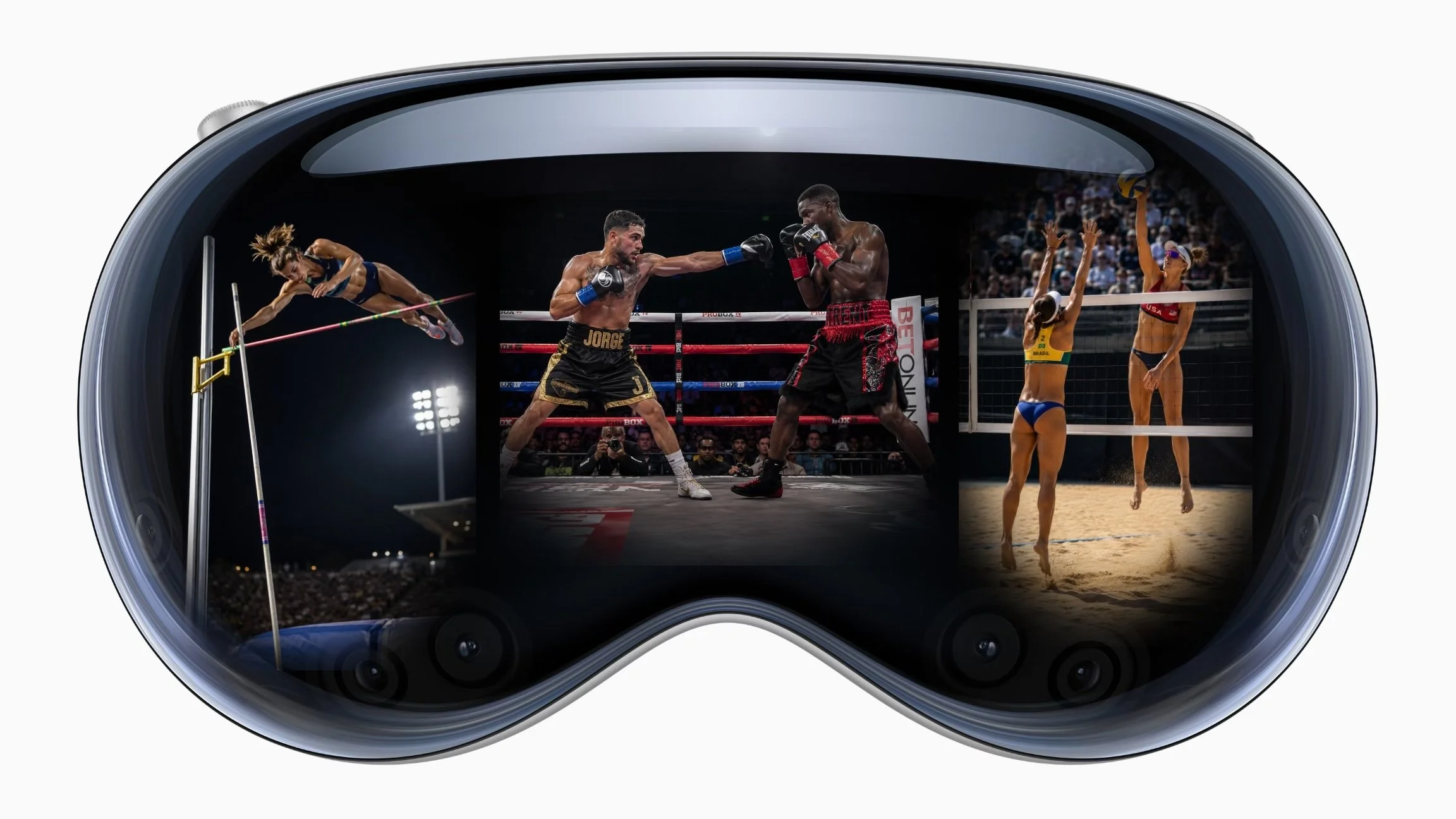
Combat sports are an obvious fit because almost all of the action occurs within a small ring or cage. The physical boundaries also help define where athletes can go, potentially allowing immersive cameras to be placed very close to the action while remaining safely outside the competition area.
For boxing, kickboxing, and Muay Thai, an immersive camera near ringside could effectively give every viewer a premium ringside seat.
MMA presents an additional challenge because of the cage. Conventional MMA broadcasts sometimes shoot through the fence and frequently position cameras above it. Shooting through the fence could be problematic for stereoscopic immersive video because the nearby fence may produce distracting depth effects. Positioning immersive cameras just above the cage may therefore be a better solution.
Combat sports also have passionate fan bases accustomed to paying for premium events, making them particularly interesting commercially.
Track & Field
Pole vault, high jump, long jump, triple jump
Although a track-and-field stadium is enormous, several individual events have surprisingly compact action volumes.
High jump and pole vault may be particularly strong AIV candidates. In both events, the athlete follows a predictable path toward a fixed location and then moves dramatically upward through the viewer's field of view. A nearby immersive camera could provide a much better sense of the height of the bar and the athleticism required to clear it.
Pole vault could be especially spectacular as an athlete approaches from a distance, plants the pole, accelerates upward, rotates over the bar, and drops onto the landing mat—all within a relatively small three-dimensional volume. The viewer will literally look up to watch the athlete soar overhead.
Long jump and triple jump also offer interesting possibilities. Rather than attempting to capture the entire approach, an immersive camera could concentrate on the final portion of the run, takeoff, flight, and landing.
Other track events could work using the same action-volume approach. An immersive camera might be positioned near a hurdle, the steeplechase water jump, a relay exchange zone, or the finish line. The entire race does not need to occur close to the viewer; the athletes instead repeatedly enter a carefully selected immersive viewing area.
Net and Racquet Sports
Tennis, volleyball, beach volleyball, table tennis, pickleball
Net sports offer another useful characteristic: the net divides the playing area and makes player movement relatively predictable.
Table tennis is particularly compact, with players and the ball repeatedly moving toward and away from the viewer. The table itself provides a strong depth reference that could make the stereoscopic effect particularly noticeable. Table tennis is extremely popular in China, Japan, and South Korea, important markets for Apple.
Volleyball and beach volleyball add substantial vertical movement as players jump to spike and block the ball. An immersive view could provide a much better appreciation for how high elite volleyball players actually jump.
Beach volleyball may be especially interesting because there are only four athletes on the court, reducing visual clutter while keeping the action relatively compact.
Tennis has a larger playing area, making distant players more challenging to present clearly, but carefully chosen positions near the net or court could still provide perspectives unavailable to spectators during a conventional match.
Fencing
Fencing has a relatively small audience compared with sports such as tennis or boxing, but its physical characteristics make it particularly well suited to Apple Immersive Video.
Competition takes place on a long, narrow piste, so the athletes' movements are highly constrained and predictable. An immersive camera positioned safely alongside the piste could keep both competitors relatively close while capturing rapid movement toward and away from the viewer.
That last characteristic could be particularly important. Conventional television tends to flatten the distance between fencers, while stereoscopic immersive video could provide a much better sense of their footwork, distance, timing, and explosive attacks.
Fencing could therefore be an example of a sport that becomes more compelling to a casual audience when experienced immersively.
Ice Sports
Figure skating and short-track speed skating
Figure skating takes place over a larger area than many of the sports considered here, but it has several characteristics that could make it compelling in immersive video. Skaters move quickly through three-dimensional space and perform jumps, spins, and lifts that could benefit substantially from stereoscopic presentation.
Rather than relying on a single camera to cover the entire rink, multiple immersive cameras could be positioned around it, with an edited presentation selecting the best viewpoint for different portions of a performance. The result could give viewers perspectives much closer to the ice than even premium arena seats.
Short-track speed skating offers a different opportunity. The entire race takes place on a relatively small oval, with groups of skaters repeatedly passing the same locations at high speed. Cameras positioned safely around the outside of the course could allow viewers to experience the speed of the athletes as they approach, sweep through a turn, and accelerate away.
Both sports also benefit from their popularity during the Winter Olympics, potentially giving Apple compelling seasonal sports content beyond the traditional major professional leagues.
Equestrian Sports
Horse racing, steeplechase, cross-country, and show jumping
Equestrian sports present an interesting opportunity for Apple Immersive Video because they combine large, fast-moving subjects with passionate audiences. Horses should remain visually impressive at distances where smaller subjects, such as distant baseball players, become difficult to see clearly.
Horse racing is particularly interesting even though the overall track is far larger than AIV's ideal viewing area. Instead of trying to keep the horses close throughout the race, immersive cameras could be placed at locations where the action predictably comes to them.
One camera could capture the start, with a field of horses accelerating away from or past the viewer. Additional cameras could be positioned at key locations around the track, such as near turns, where the horses approach as a group and sweep through the viewer's field of view. A camera near the finish could capture the field charging toward and past the viewer. With a typical race lasting about 2 minutes, there would only need to be a camera change roughly once every 40 seconds, not too distracting for the viewer.
An edited presentation could move between these fixed immersive viewpoints as the race progresses, giving the viewer a succession of premium perspectives rather than trying to follow the race continuously from a distant camera.
Steeplechase racing provides an additional opportunity because the jumps create predictable locations for spectacular action. An immersive camera positioned safely near a major fence could capture the field approaching from a distance, jumping nearby, and racing away.
Cross-country equestrian events take this concept even further. A cross-country course may cover kilometers, making continuous immersive coverage impractical. But individual obstacles provide natural immersive stages. Cameras could be positioned at a selection of particularly dramatic jumps, water obstacles, drops, and combinations. The horses and riders would repeatedly enter these relatively small action volumes before continuing along the course.
Show jumping may be an even more straightforward candidate. Although competitors move throughout an arena, the location of every jump is known in advance. Cameras could be positioned near selected obstacles where horses repeatedly approach, jump, and land within a predictable area.
Equestrian sports also have an interesting commercial characteristic. They attract a dedicated audience that includes participants and enthusiasts accustomed to spending significant amounts on horses, equipment, training, competitions, and related experiences. That does not necessarily translate directly into Apple Vision Pro purchases, but it makes equestrian sports worth considering when looking for passionate audiences receptive to premium experiences.
More broadly, equestrian events illustrate an important principle for immersive sports production: the entire sport does not have to fit within AIV's ideal viewing range. The most compelling action does.
Aquatics
Springboard and platform diving
Diving combines a highly predictable athlete trajectory with dramatic vertical movement. An immersive camera positioned safely near the pool could capture the diver leaving the board or platform, rotating through space, and entering the water.
Platform diving could be particularly impressive because immersive video may communicate something conventional television struggles to convey: just how high a 10-meter platform feels when viewed at human scale.
The location of the action is also extremely predictable, making it possible to establish camera positions without worrying about athletes unexpectedly moving into the camera area.
Action Sports
Skateboarding and BMX freestyle
Skateboarding and BMX freestyle take place over larger areas, but ramps, bowls, rails, and other fixed features create predictable locations where spectacular action occurs.
Rather than trying to cover an entire course equally, immersive cameras could be positioned near selected features where athletes repeatedly jump, rotate, and move through three-dimensional space.
These sports could produce particularly dramatic AIV sequences. A BMX rider launching from a ramp several meters away and rotating through the viewer's field of view, for example, could provide exactly the kind of experience that demonstrates the difference between immersive video and conventional television.
These sports may also help Apple reach younger audiences who might otherwise have relatively little interest in some of the more traditional sports discussed above.
Live Versus Prerecorded Sports
Many of these sporting events do not need to be streamed live.
Some competitions, such as track meets and gymnastics meets, can take hours to complete, with long periods during which relatively little happens. A pole vault competition, for example, might take several hours, while each attempt lasts only seconds.
Prerecording these events and editing them down to emphasize the best performances could create a much more compelling experience.
An edited pole vault program could show the best attempts, athlete reactions, and alternative camera positions while eliminating much of the waiting between attempts. The same approach could turn a lengthy track meet into an hour of spectacular immersive highlights spanning high jump, pole vault, long jump, triple jump, hurdles, and other events.
Prerecording also opens up possibilities for sports played over much larger areas.
A horse race or cross-country equestrian event, for example, could be recorded using immersive cameras at several key locations. Rather than watching distant athletes travel between those cameras, an edited presentation could move from one immersive action volume to the next as the competition progresses.
Figure skating could similarly be recorded from multiple positions around the rink, allowing editors to select viewpoints that best complement different portions of a performance.
Recorded programming also gives producers another important advantage: storytelling. Athlete profiles, interviews, explanations of the competition, reactions, slow-motion sequences, and alternative camera angles can be incorporated without forcing viewers to sit through hours of competition.
In some respects, this could resemble a modern immersive version of ABC's Wide World of Sports ("the thrill of victory and the agony of defeat"). Rather than attempting to build an immersive equivalent of a traditional live sports network, Apple could seek out visually compelling sports from around the world, capture them exceptionally well, eliminate the uninteresting portions, and package them into programs designed specifically around the strengths of immersive video.
The question then changes from:
Can this entire sport be shown effectively in immersive video?
to:
Does this sport contain moments that would be extraordinary in immersive video?
That substantially increases the number of potential sports.
Sports as a Driver for Apple Vision Pro
Ultimately, Apple should have two related goals when producing content for Apple Vision Pro:
1. Produce unique experiences compelling enough to encourage people to buy an expensive headset.
2. Produce enough compelling content to encourage Apple Vision Pro owners to put their headsets on regularly.
Those goals are related but different.
A spectacular immersive view of a gymnast on the rings, a pole vaulter clearing the bar, a boxer fighting just a few meters away, a diver dropping from a 10-meter platform, or a field of racehorses charging toward the viewer might help demonstrate why someone would want an Apple Vision Pro in the first place.
These are potentially "you have to see this" experiences—content that AVP owners show to friends and family because a television, phone, or tablet cannot reproduce the experience.
A regular cadence of sporting events could then address the second goal by giving existing owners reasons to return to their headsets week after week.
This suggests that Apple could pursue two complementary approaches to sports.
The first is to bring extremely popular sports such as baseball and basketball to Apple Immersive Video. These sports give existing fans a new way to watch something they already love.
The second is to identify sports whose physical characteristics make them unusually well suited to immersive video—even if those sports normally attract smaller television audiences.
Gymnastics, combat sports, selected track-and-field events, net and racquet sports, fencing, figure skating, short-track speed skating, equestrian sports, diving, and action sports all have the potential to provide experiences that aren't simply better views of television sports.
They could provide sports experiences that would be difficult to reproduce on a television at all.
Sports—and a regular cadence of sports content—could therefore help Apple accomplish both of its goals: selling Apple Vision Pro by demonstrating experiences that cannot be replicated elsewhere, and giving existing owners compelling reasons to keep putting the headset back on.
Postscript: Universities as Early Adopters
Many of the sporting events discussed above are also part of university athletic programs.
Universities often have their own video production and marketing teams, and they have historically been early adopters of emerging technologies. This could make them ideal candidates for adopting Apple Immersive Video to capture sporting and other campus events.
Immersive experiences could give universities new ways to tell their stories and engage prospective students, student-athletes, alumni, and donors. Imagine allowing a prospective gymnast to experience a meet from the competition floor, giving alumni an immersive view of a major campus event, or bringing donors closer to university programs than traditional 2D video can.
There could also be a particularly compelling audience among the families of student-athletes. I can easily imagine parents buying Apple Vision Pros to experience their children's performances immersively—especially when distance prevents them from attending in person. Instead of simply watching their son or daughter compete on a television screen, they could experience the event from a perspective that feels much closer to actually being there.
Universities could therefore provide an interesting proving ground for immersive sports production: they have the events, audiences, production capabilities, and incentives to experiment with new ways of bringing people closer to their campuses.