Content Requirements: Volume, Velocity, and Variety
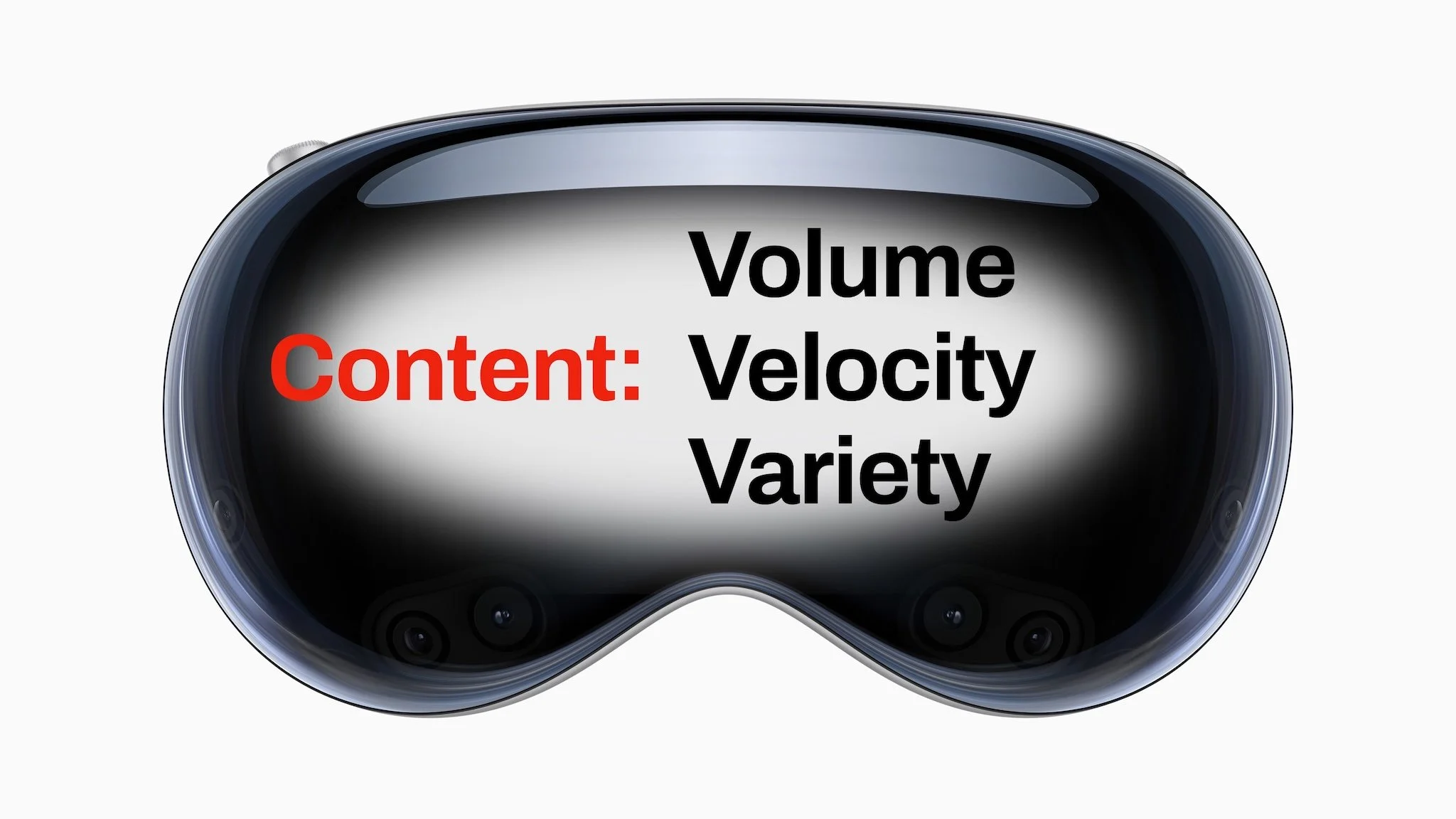
Spatial computing content requirements: volume, velocity, and variety
3 Oct 2026
People often talk about the need for a “killer app” before a new platform like spatial computing can take off. Classic examples include VisiCalc for the Apple II, desktop publishing (Apple LaserWriter plus Aldus PageMaker) for the Mac, and the World Wide Web for the Internet. While several strong use cases unique to a platform can help drive adoption, the volume, velocity, and variety of content are critical to sustaining a platform’s growth, especially for consumable content like entertainment.
Volume, Velocity, and Variety
Volume is the amount of content available. Apple once ran an advertising campaign with the catchphrase “There’s an app for that.” During the growth of the streaming video market, access to large back catalogs was also seen as an important requirement for success. Both examples illustrate the value of having a large volume of content available for users to explore.
Velocity is the rate at which new content becomes available. This is particularly important for media such as movies and episodic shows, which users may consume only once or a few times. A steady stream of new content gives users a reason to return to the platform regularly. If users do not come back regularly, they may eventually abandon the platform altogether.
Variety is the range of content available. People have different interests, particularly when it comes to entertainment, and even an individual user’s interests can change with their mood. A platform can have a large volume of content and a high velocity of new releases yet still have limited appeal if much of that content is similar. Supporting a broad range of interests and experiences helps a platform appeal to a broad user base while giving existing users more reasons to return as they discover types of content they didn’t even realize they liked.
Strong use cases unique to a platform—the “killer apps”—can help drive initial adoption. But sustaining growth requires more. It requires enough content, a steady supply of new content, and sufficient variety to attract new users and keep existing users engaged.
Fumbling the Future
Perhaps Apple’s biggest failure with the Apple Vision Pro over its first several years has been the lack of content, especially immersive video, which was a hit feature with journalists who previewed the Vision Pro at WWDC in June 2023.
Sports was especially interesting, given that sports fans regularly pay for additional streaming content and extraordinary amounts of money to see games in person. Sports fans Ben Thompson and John Gruber were particularly enthusiastic about basketball and baseball in Apple Immersive Video after seeing demos at WWDC 2023.
Apple Vision, Ben Thompson, 6 June 2023
What was much more compelling were a series of immersive video experiences that Apple did not show in the keynote. The most striking to me were, unsurprisingly, sports. There was one clip of an NBA basketball game that was incredibly realistic ...
... I am completely serious when I say that I would pay the NBA thousands of dollars to get a season pass to watch games captured in this way. Yes, that’s a crazy statement to make, but courtside seats cost that much or more, and that 10-second clip was shockingly close to the real thing.
First Impressions of Vision Pro and VisionOS, John Gruber, 7 June 2023
For the baseball game, the perspective wasn’t even from the stands, but rather from the home team’s dugout, ground level, right behind first base. It’s not quite just like being there, but it’s a lot like being there. It’s more realistic than seems possible. You choose where to direct your gaze: at the batter at home plate, at the pitcher, or out in the outfield. Or above the outfielders, at the scoreboard. ... It looks real. It seems as profoundly different from watching regular TV telecasts of sports as TV telecasts are from audio-only radio broadcasts. It was incredible. I would genuinely consider buying a Vision Pro if the one and only thing it did was show entire sporting events like this.
Yet it would be two and a half years after the WWDC 2023 preview before Apple and the NBA showed the first immersive basketball games, and nearly three and a half years before Apple and MLB showed the first immersive baseball games. And even then, there were only six NBA games and four MLB games in total.
Music performances were expected to be another big draw for immersive video. Apple previewed a practice session with Alicia Keys in Apple Immersive Video to journalists in 2023. In 2024, Apple launched its “Concert for One” Apple Immersive Video series with the description, “Enjoy exclusive, up-close access to private performances from today’s most electrifying artists.” (Emphasis on the plurals is mine.) The first episode featured RAYE. In the nearly two years since, Apple has yet to release a second episode.

Concert for One. There was never a second episode.
Beyond Apple Immersive Video, Apple showed journalists “Encounter Dinosaurs” at WWDC 2023, an innovative, true six-degrees-of-freedom 3D storytelling experience shown mostly through a portal in your room, but with a dinosaur briefly coming into your space. Apple has not released another similar experience.
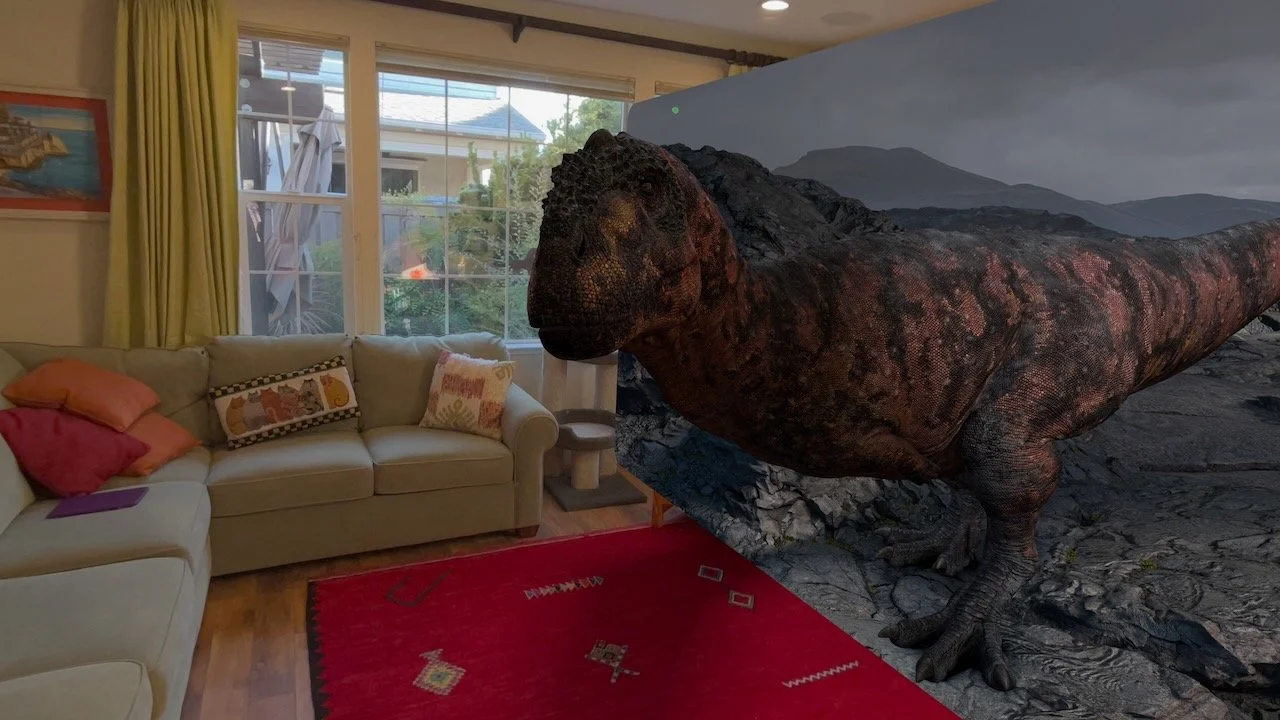
Encounter Dinosaurs. There hasn’t been a second experience.
When the Vision Pro launched in early 2024, Apple had a paucity of content. After an hour or so of experiencing the innovative content available, many early adopters were left asking, “Is that it?”
And new content came out at an anemic rate, with users often waiting well over a month between new Apple Immersive Video releases. Each new video was typically only 5–15 minutes long.
Apple failed spectacularly on the volume and velocity requirements for innovative content on its amazing new platform.
Good News for Apple
There is good news for Apple, though. No competitor has successfully executed on content for their spatial computing platform either.
While Apple failed in its content strategy and execution, Meta completely FUBARed theirs. After spending tens of billions of dollars to create “the Metaverse”—including creating Horizon Worlds and Horizon Workrooms, acquiring many VR game companies, and renaming the company from Facebook to Meta to reflect the importance of the Metaverse—Meta has stopped its VR work on the Metaverse and shut down most of its game studios. Meta’s CTO, Andrew “Boz” Bosworth, described the effort as a “legendary misadventure.” The “Metaverse” was absent in Meta’s recent Connect 2026 event. Meta has essentially rebooted its content strategy.
And Google and Samsung’s Galaxy XR? No one is really talking about it.
Snapchat’s SPECS are more of a technology demonstration.
Valve’s Steam Frame has not really moved beyond the PCVR niche the company helped pioneer with the HTC Vive in 2016.
More Good News
While Apple has delivered only a single hardware speed bump to the Vision Pro in the three and a half years since unveiling it, and has done poorly as a content producer, it has done considerably more to enable others to become content creators. Apple continues to iterate on its operating system, libraries, tooling, and ecosystem.
Apple is a co-founder of the Alliance for OpenUSD and is helping advance Universal Scene Description (USD) as a formal industry standard, including contributing to the first OpenUSD Core Specification. Apple’s platforms also support open technologies that work alongside USD, such as MaterialX and OpenPBR for materials and OpenVDB for volumetric data. Together, these technologies make it easier for creators to build rich 3D content in third-party tools like Blender, Houdini, and Maya and bring it to visionOS, iOS, iPadOS, macOS, and tvOS.
Apple developed RemoteImmersiveSpace, Spatial Preview, and Foveated Streaming to let users share 3D content from their Mac, PC, or the cloud to the Vision Pro.
Apple developed Apple Projected Media Profile (APMP) to support 180-degree, 360-degree, and wide-FOV/fisheye video from a range of popular third-party cameras, making the Apple Vision Pro one of the best ways to experience this content. Apple has also defined the file format for Apple Immersive Video and created libraries that let developers bring immersive video into their apps.
Apple worked with Blackmagic to create the Blackmagic URSA Cine Immersive camera and tooling that lets third parties create, edit, and deliver their own Apple Immersive Videos. There are already a half-dozen third-party apps distributing Apple Immersive Videos from numerous creators.
As John Ternus, Apple’s new CEO, recently said in an interview with CANAL+:
We kind of think of ourselves as tool makers, right? We build products to help people be more creative, more productive
Long-term, the volume, velocity, and variety of content for the Vision platform will largely come from third parties, and Apple continues to create the tools developers and creators need to make this happen.
Summary
One key to a platform’s success is content such as apps and experiences. There must be a significant volume of content for users to explore at any given time, a steady velocity of new content to encourage users to come back regularly to see what is new, and a wide variety of content to appeal to a large user base and users’ changing moods.
Apple has so far failed to create or execute a successful strategy for first-party content. Too many new Apple Vision Pro owners excitedly explore what is available, only to quickly run out of things to do or experience.
Fortunately for Apple, no other potential spatial computing rival has successfully executed on a content strategy either. Leadership in this new platform category is still very much up for grabs.
And while in the short term (i.e., the next 2–5 years), I think Apple will need to drive much of the content for the Vision platform, Apple continues to work hard to create the libraries, tooling, and external ecosystem that will eventually let third parties become a major driving force behind content volume, velocity, and variety.