Vision Display: A Modular Approach to Spatial Computing
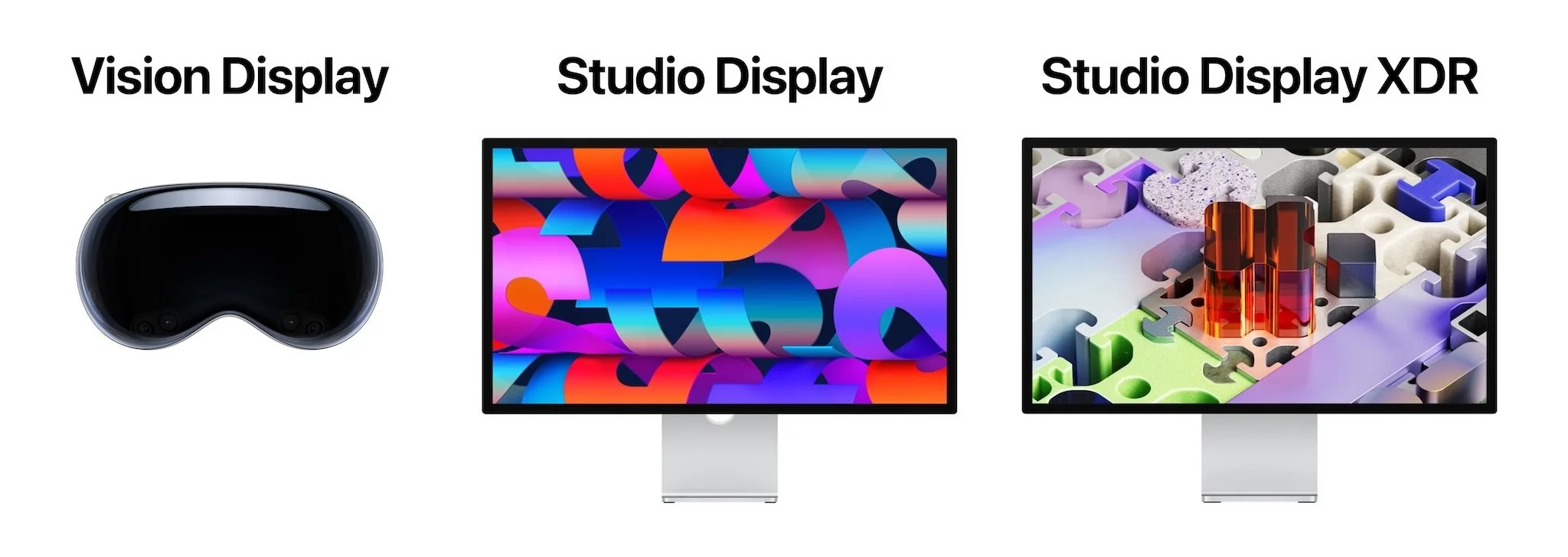
Vision Display: Key to a modular approach to spatial computing
6 Oct 2026
In Spatial Computing’s Keys to Success, I talk about cost, comfort, and content.
In Content Requirements: Volume, Velocity, and Variety, I focus on content.
In this post, I focus on cost and comfort, and why I believe a significant redesign of the Vision platform is needed to address them.
Briefly, the approach repositions the headset as a display—essentially a spatial monitor. The primary compute can be moved into a puck, as with the Meta VR Glasses and Magic Leap headsets, or the Vision Display can be connected directly to a Mac for power and compute, as with PCVR headsets.
Moving the primary compute, RAM, and storage out of the headset could make it cheaper to build. With less heat generated inside the headset, the active cooling system could be reduced or eliminated. With less space needed for compute and cooling, the headset could also be smaller. Together, these changes could produce a cheaper, lighter, and more comfortable headset.
For prospective Vision users who already own a sufficiently capable Mac, allowing the Mac to drive the spatial experience removes the need to buy a puck containing compute and a battery. This significantly lowers the cost of entering the Vision platform.
Apple would still sell a puck—a “Vision Pack”—to provide a mobile experience.
Background
Meta’s recently announced Meta VR Glasses have generated a lot of comments along the lines of, “This is what Apple Vision Pro should have been.”
Meanwhile, Mark Gurman, who has some of the best sources inside Apple, reports that Apple is working on yet another approach to a Vision headset after numerous prototypes have been canceled or shelved.
And while Apple executives, including new CEO John Ternus, have described Vision as being in its “early days” with a “bright future,” Gurman has reportedly been told that work on the platform is on “life support.”
So what should Apple do?
This post lays out the roadmap I think Apple should pursue: stop treating the Vision headset as a single, self-contained computer and instead turn it into a modular platform.
Assumptions
With the original M2 Apple Vision Pro, Apple established a baseline for what future Apple spatial computers need to deliver. That includes sufficient compute performance, low motion-to-photon and photon-to-photon latency, and high-resolution displays.
To maintain sufficiently low latency, some compute probably needs to remain in the headset. For this discussion, I will call that processor the R2, the hypothetical successor to today’s R1.
But the location of the primary compute and power is negotiable.
That distinction opens up several possible architectures.
Previously Explored Architectures
Apple and other headset manufacturers have already explored most of the major architectural approaches to spatial computing. Looking at them provides the groundwork for the modular architecture I propose.
PCVR Approach
In a PCVR architecture, the primary compute comes from an external computer, which can also provide power to the headset.
Examples include the Oculus Rift, HTC Vive, Valve Index, HP Reverb, and Varjo’s VR/XR headsets.
Apple reportedly explored a similar approach under the code name N107, moving compute and power to an external device connected to a power source.
Major advantages: The headset can be lighter, and the external computer can provide far more compute power than would be practical inside the headset.
Major disadvantages: The headset is connected to a computer, so spatial experiences are largely confined to the computer’s location. While using a laptop introduces some mobility, it isn’t ideal. Relaxing on the couch to watch an immersive movie using PCVR, for example, probably isn’t practical for most people.
All-in-One-ish Approach
In an all-in-one architecture, the primary compute resides in the headset, while the battery is either built into the headset or connected by a cable.
Recent Meta Quest headsets and the Apple Vision Pro follow this general approach.
Apple reportedly explored a variant of this architecture with lighter components under the code name N109.
Major advantages: The user can be mobile. They can walk around a scene, easily use the headset in the living room or in bed, or take it on a trip.
Major disadvantages: Weight, heat, limited compute performance, and higher hardware costs compared with PCVR.
Note 1: Quest headsets can also stream content from a PC, and Apple Vision Pro supports foveated streaming from a PC or cloud service.
Note 2: Meta has historically kept Quest prices relatively low through aggressive pricing, sometimes selling the hardware at or near cost.
Puck Approach
In a puck architecture, the headset resembles a PCVR headset: it contains the sensors and displays, but the primary compute and battery are moved to a small tethered device.
The Magic Leap headsets and the recently announced Meta VR Glasses use this basic architecture.
Apple reportedly explored a similar approach under the code name N100.
Major advantages: A lighter, more comfortable headset while retaining much of the mobility of an all-in-one design.
Major disadvantages: Limited compute and higher hardware costs compared with PCVR, along with the need to carry a tethered pack.
Summary of Previously Explored Architectures
Table 1 summarizes the primary spatial computing architectures and their relative strengths and weaknesses.
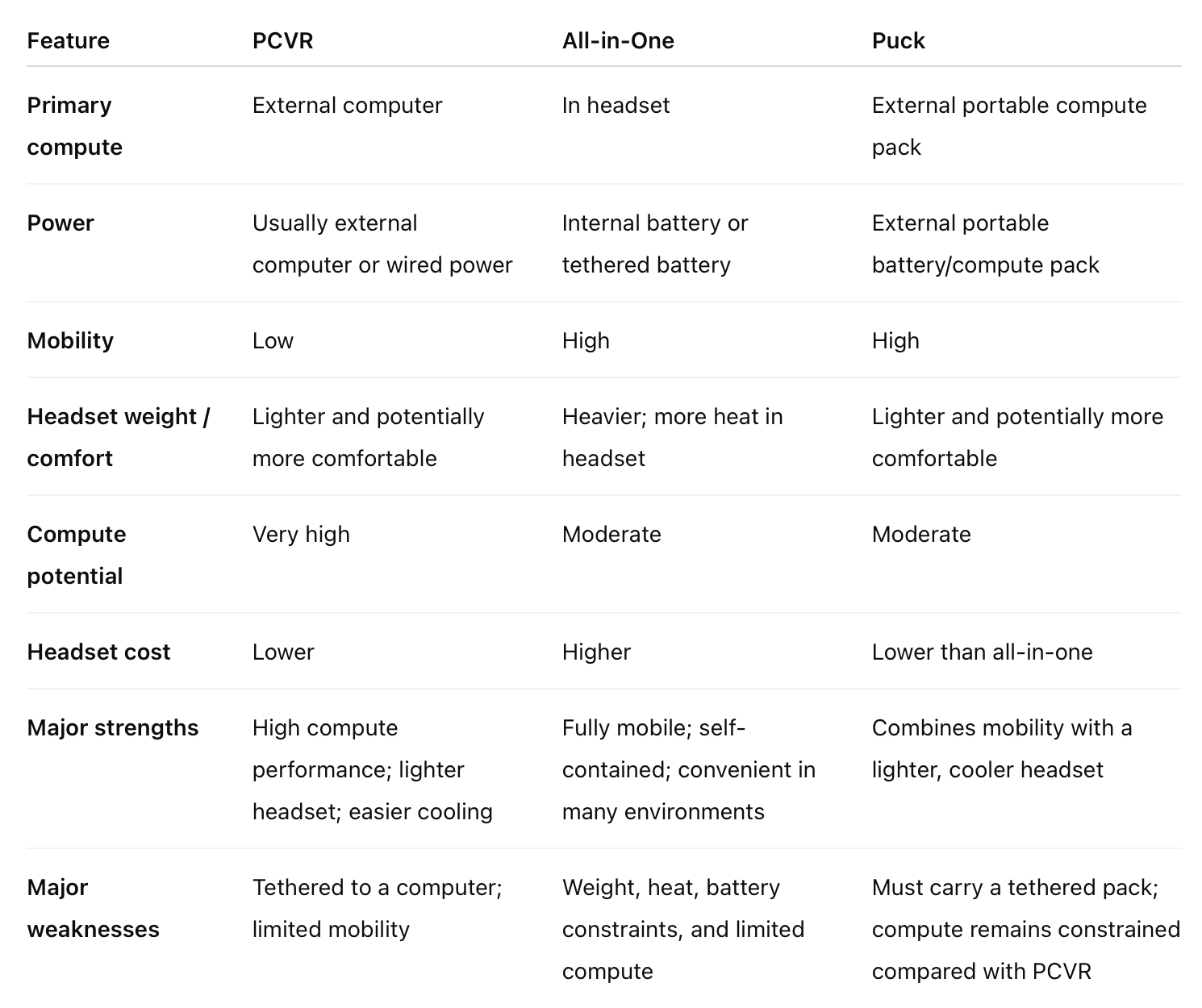
Table 1: Summary of spatial computing primary architectures
Vision Display
According to Mark Gurman, Apple is pursuing a “completely revamped headset under the code name N224,” with multiple scenarios being considered.
The approach I hope Apple pursues is what I call the Vision Display Modular Architecture.
The idea is to combine the best elements of PCVR and puck-based designs while lowering both headset weight and the initial cost of entry.
The key is the Vision Display itself.
The Vision Display would essentially be a sophisticated PCVR headset. It would contain the display panels, cameras, sensors, and latency-sensitive compute such as the hypothetical R2. But it would not contain the primary application CPU/GPU, its RAM and storage, or a battery.
Removing those components could make the headset significantly lighter, cooler, and less expensive.
Apple could even market the Vision Display alongside its Studio Display and Studio Display XDR monitors. Conceptually, it really would be another type of Mac display—except instead of presenting pixels on a rectangular panel, it would provide a spatial computing environment.
Marketing the Vision Display along with Apple’s other displays
Its price could also sit much closer to Apple’s existing displays, making the cost easier to justify.
A Vision Display owner could connect it to a desktop Mac such as a Mac mini or Mac Studio, or to a sufficiently powerful MacBook Pro. The Mac would provide the primary compute and power. In this configuration, the Vision Display would function much like a modern Apple interpretation of PCVR.
This approach also builds naturally on Apple’s existing Mac Virtual Display capabilities. visionOS can already create virtual Mac displays far larger than Apple’s physical monitors. Apple’s recent ability to move content from a Preview window on the Mac Virtual Display into an independent visionOS window also hints at where this could ultimately go: individual Mac windows could potentially become spatial windows positioned anywhere in visionOS’s “infinite canvas.”
Many potential Vision Display buyers may already own a sufficiently capable Mac, meaning they would not need to purchase another computer simply to enter Apple’s spatial ecosystem. They buy a Vision Display, and they’re in.
Then, when they want mobility, they could add a puck—what I call a “Vision Pack”—containing the primary compute and battery.
That is where the architecture becomes particularly interesting.
Apple is unusually well positioned to make this work. It controls macOS and visionOS, designs its own processors, and has substantial overlap in frameworks and development tools across the two platforms. Developers already work with Swift, SwiftUI, RealityKit, and related technologies across Apple’s ecosystem.
When a Mac drives the Vision Display, traditional Mac applications and compatible iPad apps could remain usable with the keyboard and precision pointing device the user already has, such as a trackpad or mouse. For applications that do not require precision pointing or extensive text input, Apple’s development tools, including Xcode and SwiftUI, already support interfaces optimized for gaze-and-tap interactions.
The result would be a headset that could scale from a relatively inexpensive Mac-connected display to a completely mobile spatial computer.
Major advantages:
a lighter and potentially more comfortable headset;
a lower initial cost;
the ability to scale compute independently of the displays;
access to much more powerful desktop-class compute when tethered to a Mac; and
full mobility when connected to a Vision Pack.
Major disadvantages: Apple would need to invest considerable engineering effort to support the full visionOS experience when a Mac drives a Vision Display. Developers might also be less likely to provide a mobile visionOS version of their app optimized for gaze-and-tap interactions.
Scaling Capabilities Independently
Today’s Apple Vision Pro is conceptually similar to an iMac: the computer and display are sold as a single integrated product.
You cannot upgrade the processor without replacing the displays, cameras, sensors, and enclosure at the same time.
When Apple updated Vision Pro from the M2 to the M5, the remaining headset hardware—cameras, LiDAR, R1 chip, and displays—stayed the same. Yet an M2 Vision Pro owner could not simply upgrade the processor. Getting the newer compute required buying another complete headset.
A modular architecture breaks that relationship.
Scaling Up Compute
A new Vision Display owner might initially connect it to their Mac mini.
Later, after becoming more involved in 3D content creation or other demanding applications, that person could upgrade to a high-end Mac Studio while continuing to use the same Vision Display.
The same principle would apply to mobile use.
A user could begin with a relatively inexpensive Vision Pack built around an A-series processor. If they later wanted more performance for complex 3D environments, games, or professional applications, they could replace it with an M-series Vision Pack Pro while keeping the same Vision Display headset.
Two years later, they might upgrade again to a compute pack with the latest M-series processor.
One Vision Display could therefore last through several generations of compute hardware.
Scaling Up Displays
Today’s Apple Vision Pro uses the same Sony 4K-per-eye white OLEDoS display technology with color filters introduced with the original Vision Pro in 2023.
By the 2028–2029 timeframe—roughly when Gurman has suggested another major Apple headset could arrive—newer microdisplay technology could provide improved performance. For example, Samsung is reportedly moving toward production-line planning and equipment purchases for mass manufacturing of RGB OLEDoS displays in 2028. These new panels could support up to twice as many pixels per eye as Apple’s current panels.
That gives Apple another opportunity for modularity.
Apple could offer two display tiers.
A lower-cost Vision Display could use mature, lower-cost display technology comparable to today’s Vision Pro.
A Vision Display Pro could use a newer generation of higher-resolution displays, perhaps around 5K per eye, with a wider color gamut and greater brightness.
Importantly, the choice of display would no longer dictate the choice of compute.
Someone might pair a Vision Display with a Mac Studio for high-end content creation, while another person might pair a Vision Display Pro with an inexpensive Vision Pack primarily for media consumption.
The architecture lets customers scale display quality and compute performance independently.
Table 2 summarizes how this modular architecture compares with the previously explored architectures across several features.
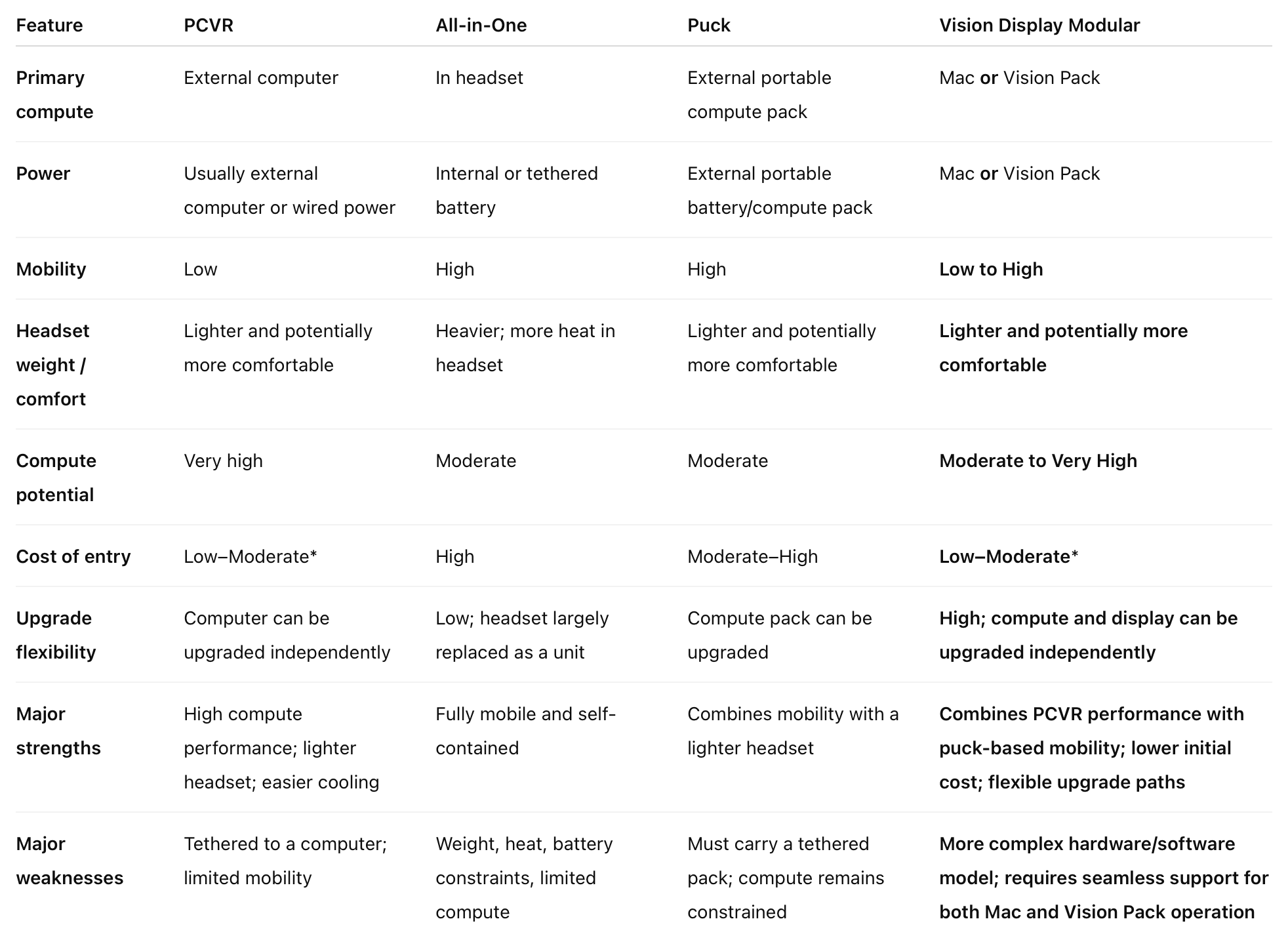
Table 2: Modular architecture compared to traditional architectures
Productivity Tool
Apple already pitches the $4,000 Vision Pro partly as a productivity device. Mac Virtual Display is one of its most compelling features, and Apple has highlighted enterprise applications ranging from monitor-based surgery to Lowe’s Style Studio for experiencing proposed kitchen remodels.
But a base Vision Display priced closer to an Apple Studio Display changes the business case.
Instead of asking customers to buy a $4,000 spatial computer, Apple could pitch the much cheaper Vision Display as a portable Mac display with an effectively infinite canvas. And unlike a Studio Display, which is typically anchored to a single desk, the Vision Display would be extremely portable.
An employee could use the Vision Display at a desk in the office during the workday, carry it home at night, or pair it with a MacBook Pro while traveling. On an airplane, in a hotel room, or at a temporary workspace like Starbucks, that employee could have access to virtual screen real estate that would otherwise require multiple large physical monitors. The employee’s work would no longer be confined to a 14- or 16-inch laptop screen.
The original Apple Vision Pro offered partial Mac integration through a moderately usable Mac Virtual Display, and Apple has steadily improved the experience. Many Apple Vision Pro owners already use it as the primary display for their Mac.
At an entry price perhaps as low as $1,400, the idea of a portable Mac display with an infinite canvas suddenly becomes a much more compelling business proposition.
Gateway to Consumer Use
The productivity use case could also become Apple’s gateway to a much larger consumer spatial-computing market.
If a business or individual can justify buying a Vision Display for work, that same headset could also offer Apple Immersive Video, 3D movies, immersive sports, VR games, and other consumer-oriented content.
The user has already crossed the largest barrier: buying the headset.
If the consumer experiences become compelling enough, that person might then buy a Vision Pack so they can use the Vision Display on the couch, in bed, or elsewhere without remaining tethered to a Mac.
That creates a natural upgrade path:
Buy the Vision Display for productivity. Discover immersive entertainment. Add the Vision Pack for mobility.
Instead of asking consumers to spend several thousand dollars upfront for an entirely new category of device, Apple could allow productivity to justify the initial purchase and entertainment to expand how the product is used.
The Family Display
A common complaint about the current $4,000 Apple Vision Pro is that it is essentially a single-user device.
The owner can let a spouse or child use the headset in guest mode, but that person does not have access to their own photos, messages, email, music, movies, and other personal content.
The Vision Display could reduce this friction.
If the family connects the Vision Display to a Mac, the Mac already supports multiple user accounts. Each family member could log in and have full access to their own personal content.
If the family connects the Vision Display to a Vision Pack running a version of visionOS that supports only a single user, another family member would need only their own Vision Pack to gain access to their private content. While this would not be as inexpensive as a single device that supports multiple users, it would still be far cheaper than buying a second Apple Vision Pro.
And, ideally from Apple’s perspective, multiple family members would like the experience so much that they would compete for time with the Vision Display—eventually leading the household to buy a second or even third one. This is similar to how many households evolved from having a single shared family computer to becoming multi-computer homes.
Summary
Today’s Apple Vision Pro demonstrates remarkable technology, but at roughly $4,000 for a headset weighing around 750–800 grams, it remains too expensive for most people to buy and too uncomfortable for many people to use for long periods.
The Vision Display Modular Architecture attacks both problems.
By moving the primary compute out of the headset and allowing either a Mac or a portable Vision Pack to supply compute and power, Apple could make the headset lighter and less expensive. It could also combine the performance advantages of PCVR with the mobility of standalone spatial computing.
And by separating displays from compute, users could upgrade each independently rather than replacing an entire headset every time either technology improves.
Table 3 illustrates what such a product family might look like around 2028–2029, including possible product names and target prices. Mac prices are not included because the Mac-connected use case assumes the customer already owns one.
At the bottom of the table are two complete mobile configurations: Apple Vision, combining the Vision Display with an A-series Vision Pack, and Apple Vision Pro, combining the Vision Display Pro with an M-series Vision Pack Pro.
Under this hypothetical pricing, Apple Vision would start around $2,000, while Apple Vision Pro would remain around $4,000.
A user who already owns a sufficiently capable Mac could enter the Vision platform for just $1,400, dramatically lowering the barrier to entry from today’s $4,000.
The critical difference is that customers would no longer have to buy the entire system at once—or replace the entire system when only one component becomes obsolete.
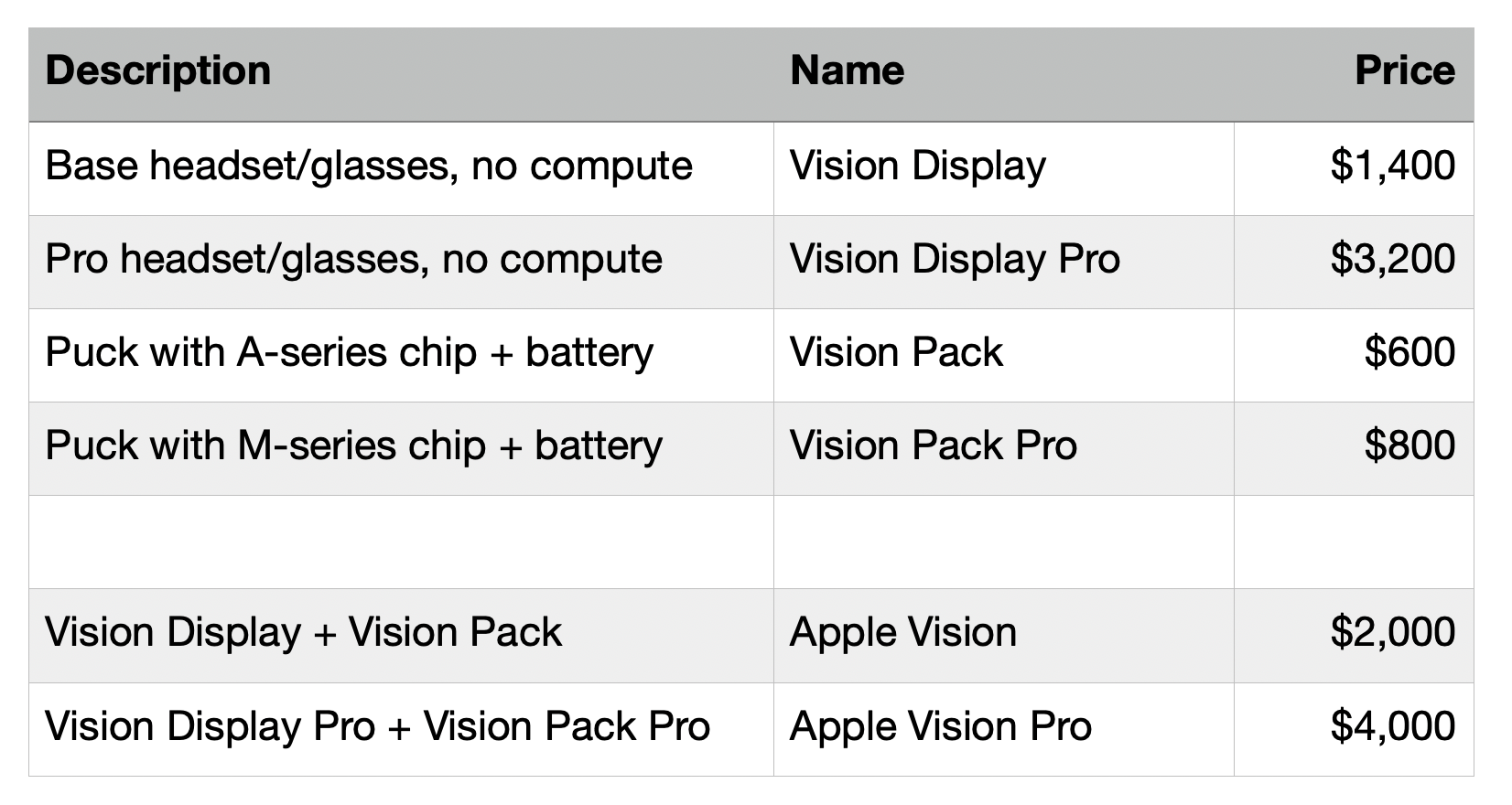
Table 3: Vision family
References
Samsung Display Unveils Advanced R&D Achievements at Display Week 2025
2025-05-13
Samsung announces “its industry-leading 5,000 PPI RGB OLEDoS … the display delivers higher resolution than an 8K TV. Designed for next-generation extended reality (XR) devices, it boasts ultra-high resolution alongside peak brightness of up to 15,000 nits, a 120 Hz refresh rate, and up to 99% color gamut coverage (DCI-P3 standard).”
SDC to Invest 300 Billion Won in RGB OLEDoS
2026-09-16
Discusses Samsung’s plan to finalize investment to to support mass production of RGB OLEDoS.
Meta’s VR Glasses Are What the Apple Vision Pro Should Have Been
2026-09-27
Mark Gurman summarizes various Apple Vision Pro projects, past and present, along with their code names.